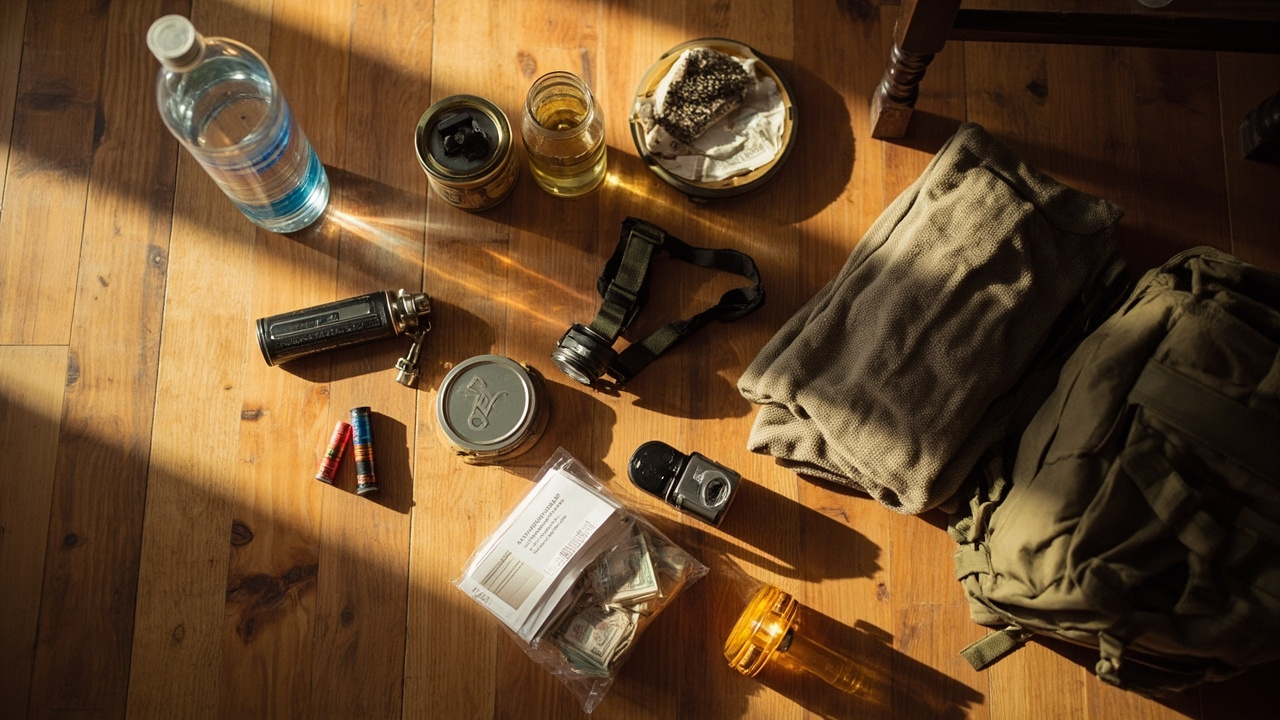
TL;DR: The UK's Be Ready checklist defines a 72-hour kit as three days of drinking water at three litres per person per day, shelf-stable food, a torch with spare batteries, an FM radio, a charged power bank, first aid supplies, cash and printed documents.
That advice became official on 22 October 2026, when the Cabinet Office published updated household guidance as the first stage of a three-year campaign. The department said the existing Prepare site had been refreshed, with much of the advice unchanged. Demand moved soon after: Axios reported on 19 November 2026 that Survival Frog's sales rose 450% between 27 October and 16 November compared with prior weeks, citing CEO and founder Byron Walker, and that most buyers were new customers.
The Be Ready checklist fixes quantities, names substitutes and covers the items households tend to forget.
Water and food: the numbers the guidance sets
Drinking water is listed at three litres per person per day, with the caveat that cooking and washing need more on top. The Guardian reported that the advice amounts to up to nine litres of bottled water per person, plus three days of food.
Food is defined by shelf life and effort: three days of non-perishable supplies that need neither refrigeration nor cooking. The examples include tinned fish, meat or vegetables, plus nuts and dried fruit, and the guidance asks households to buy food they would normally eat. Household-specific needs sit alongside that list: medical supplies, baby formula and pet food.
Light, information, power and paperwork
Torches appear with spare batteries, and the checklist states that torches are safer than candles. Blankets, sleeping bags and warm clothing share the same category, because the guidance notes that homes become cold quickly when heating stops.
Communication means a battery-powered or wind-up FM radio, with the frequencies of the national or local stations a household relies on for news written down. A charged power bank is listed for phones and compatible medical devices.
The paperwork section covers cash, both coins and notes, as well as cards, since electronic payments and cash machines may be disrupted; printed copies of identity documents such as passports and birth certificates, insurance paperwork and equipment instructions; a written contact list that includes anyone who might need checking on; and a medication list with doses.
First aid items are itemised too: plasters, bandages, sterile dressings, gloves, tape and tweezers, along with a thermometer, antiseptic and eyewash. The same page advises requesting repeat prescriptions up to five working days before medicine is needed.
For infants, ready-to-feed formula is preferred because boiling water may not be available, and nappies and wipes are listed. Pet food and bottled water complete the household section.
Why the government published the checklist
The Cabinet Office tied the campaign to disruption from severe weather, pointing to storms the previous winter and wildfires that summer. The Guardian reported that the guidance responds to concern about the climate crisis, dependence on technology and threats from hostile states.
Two figures frame the campaign. A written statement from Security Minister Dan Jarvis on 22 October 2026 cited Cabinet Office research finding that 13% of people in the UK said they were ready for a disruption that severed access to essential services, and that 84% wanted the government to do more to explain what to do. Jarvis said: "Those who can follow this advice should follow this advice."
The statement names two priority actions: joining the Priority Services Register where eligible, and holding bottled water and non-perishable food sufficient for three days. More than 500 organisations, from charities to businesses, had signed up to share campaign material, and the government said social media and radio advertising would follow over the coming weeks and months, aimed in part at older people and families with young children.
Three days is a European benchmark
The Cabinet Office says the same three-day benchmark is used by France, Ireland and the Netherlands. The European Commission has urged citizens to prepare for the first 72 hours after a disaster.
Portugal has turned that into a phone app. Euronews reported on 10 November 2026 that K72 SMPC Montijo, created by Carlos Batista with the municipal civil protection service of Montijo, walks users through a 45-item evacuation pack spanning water and food, shelter and cover, fire and cutting tools, rope, hygiene and medication, communications and power, documents and navigation. Named items include LifeStraw filters, water purification tablets, portable power stations and a kit for the Meshcore network, which the app's creators describe as a way to communicate when mobile networks fail.
The app runs with or without an internet connection while the device has battery, keeps user data on the device, and flags food or medicine that is nearing expiry.
What shoppers are putting in the bag
Axios reported that food leads demand at Survival Frog, with canned meats first, followed by radios, solar generators, battery packs and water filters. Michael Mills, a University of Greenwich senior lecturer who studies doomsday preparation, described some buyers as turning to "lightweight versions" of traditional prepping. The outlet also reported that officials have said the incidents are not broadly connected, and that Vice President JD Vance told Fox News' Laura Ingraham that he did not see a crisis coming.
A kit can be assembled over weeks
The checklist recommends auditing cupboards first, noting what is missing, then adding items during ordinary shopping trips. It suggests setting a six-month reminder for expiry checks and revisiting the kit when a household's needs change, and it encourages households to discuss with neighbours what they could share if services fail.
The Priority Services Register is the free step: it lets gas, water and electricity suppliers identify customers who may need extra support. The checklist says it operates in England, Scotland and Wales, with Customer Care Registers in Northern Ireland.
The British Red Cross, which last updated its 72-hour household guidance on 30 October 2026, reports that around 40% of people in the UK believe they could act to protect their household if a disaster struck. Its guidance asks households to consider which services they depend on — power, transport, water and communications — and how they would cope without them.