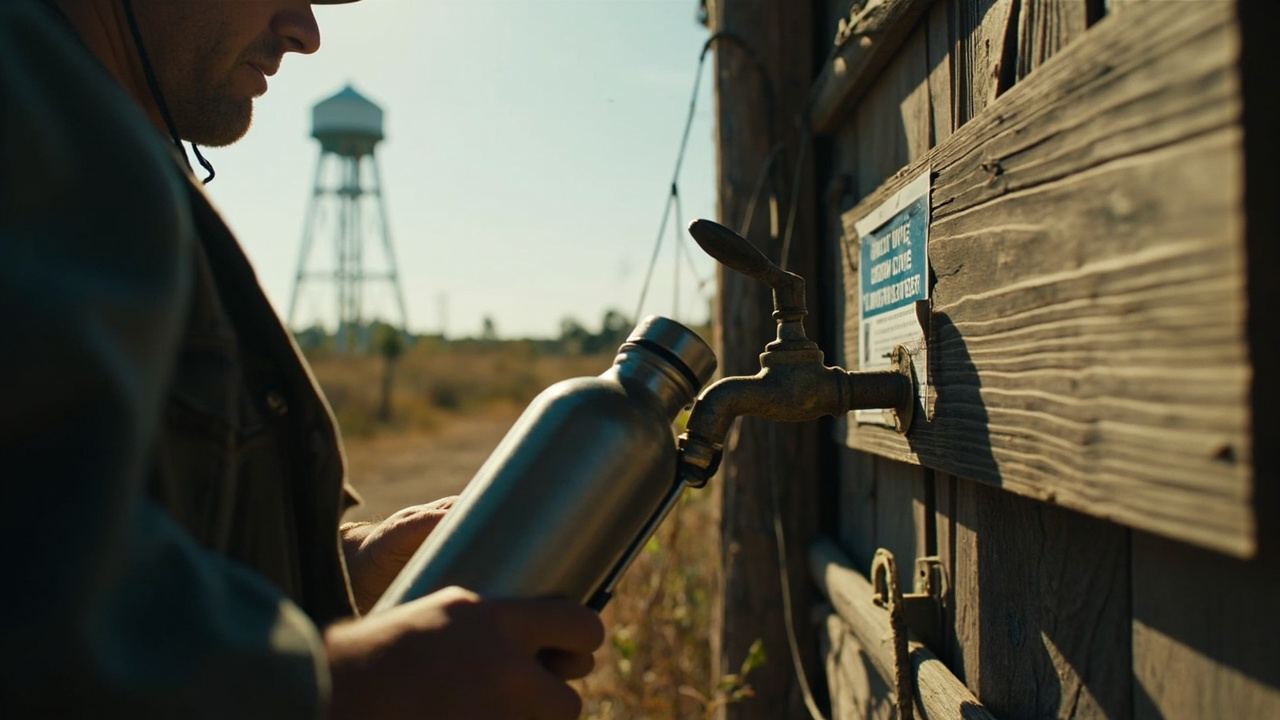
TL;DR: The EPA's Safe Drinking Water Information System tracks violations by 150,000 public water systems and makes them public through ECHO, giving outdoor travelers a way to check tap-water safety before they drink.
Federal drinking-water oversight rests on a single compliance backbone. According to AI Analytics, the Safe Drinking Water Information System tracks every violation of the Safe Drinking Water Act by the 150,000 public water systems in the United States, covering health-based violations for exceeding maximum contaminant levels, monitoring failures, reporting violations, and treatment technique violations.
That structure matters for prepared adventurers because roadside stops, campgrounds, rural rentals, and small towns all draw from regulated systems with different testing duties. Understanding the categories, the alert timelines, and the public search tools helps you judge a boil notice, a posted campground warning, or a strange-tasting tap.
How the Safe Drinking Water Act created national tracking
Congress enacted the Safe Drinking Water Act in 1974 in response to growing evidence that tap water in American cities contained chemical contaminants that state and local programs were not adequately controlling, according to AI Analytics. The law gave the EPA authority to establish national drinking water standards and required public water systems to comply with them.
The act was substantially amended in 1986 to mandate standards for a specific list of 83 contaminants and to establish new requirements for filtration and disinfection of surface water supplies. The 1996 amendments shifted to risk-based prioritization, under which EPA is required to evaluate at least 30 contaminants on a five-year cycle and decide which warrant new maximum contaminant level regulations.
The Safe Drinking Water Information System, maintained by the EPA Office of Water, is the national database that tracks compliance across all regulated public water systems. State primacy agencies — the state drinking water programs holding day-to-day regulatory authority — report violation data to SDWIS through a federal reporting interface.
EPA uses SDWIS to compile national compliance statistics, identify high-priority enforcement targets, respond to congressional inquiries and public records requests, and support the biennial Safe Drinking Water Act compliance reports to Congress. The public-facing version of SDWIS data is accessible through EPA's ECHO platform.
What counts as a public water system
A public water system under the law is any system that provides piped water for human consumption and serves at least 25 people or has at least 15 service connections year-round, according to AI Analytics. The 150,000 regulated systems range from major urban utilities serving millions of people from sophisticated treatment plants with multiple barriers to rural systems serving a few hundred residents from a single groundwater well with minimal treatment infrastructure.
That size range explains why two taps can carry very different risk profiles. A metropolitan plant may have redundant filtration, laboratory staff, and continuous monitoring. A single-well rural utility may depend on one operator, periodic sampling, and simple chlorination.
For backcountry and road-trip planning, the definition also sets expectations. Piped roadside businesses, campgrounds, and small community supplies can be regulated systems. Dispersed springs, creeks, and unpiped sources are not covered by the same compliance system and need field treatment.
Three system types set testing duties
EPA classifies public water systems into three categories based on population served and nature of service, according to AI Analytics.
Community systems serve homes year-round
Community water systems serve the same population year-round through residential utilities supplying homes, apartment buildings, and businesses in permanent communities. There are approximately 51,000 such systems in the United States. They serve roughly 295 million Americans and face the most comprehensive set of federal regulations.
Examples range from large metropolitan utilities — the New York City DEP system, the Los Angeles DWP, the Chicago Department of Water Management — to small rural cooperatives and municipal utilities serving a few hundred households.
Non-transient systems serve schools and workplaces
Non-transient non-community water systems regularly serve the same 25 or more people at least six months per year, but those people are not permanent residents. Schools, offices, factories, and hospitals operating their own supply fall into this category. There are approximately 17,000 such systems.
Because the same individuals drink the water repeatedly, they are subject to long-term exposure standards for chronic health effects — the same nitrate, arsenic, and disinfection byproduct rules that apply to community systems.
Transient systems serve travelers
Transient non-community water systems serve a changing population from day to day. Rest areas, campgrounds, gas stations, and restaurants with their own water supply fall into this category. There are approximately 82,000 such systems, making them the largest category by count though they serve the smallest share of total population.
Because exposure is transient, these systems are subject only to standards for contaminants posing acute health risks from single or short-term exposures — principally microbial and nitrate standards. That distinction is directly relevant to campers and drivers filling bottles at trailheads, parks, and highway stops.
Four violation categories separate health risk from paperwork
Federal regulators distinguish health-based failures from procedural failures, according to AI Analytics. The four principal categories are health-based violations for exceeding maximum contaminant levels, monitoring failures, reporting violations, and treatment technique violations.
An MCL exceedance means a regulated contaminant was present above its legal limit. A treatment-technique violation means a required barrier — filtration, disinfection, corrosion control, or another mandated process — was not applied or maintained as required. Monitoring and reporting violations mean required sampling, testing, or paperwork did not occur on schedule, leaving safety unverified.
The contaminants driving serious enforcement include lead and copper, nitrates, coliform bacteria, arsenic, disinfection byproducts, and the new PFAS maximum contaminant levels finalized in 2024. Private wells remain outside this structure: approximately 42 million Americans on private wells sit entirely outside federal oversight.
Alert tiers tell you how fast to act
The EPA Public Notification Rule requires every public water system to alert the people it serves whenever drinking water fails to meet a federal safety standard, according to LegalClarity. The rule sorts violations into three tiers based on how quickly harm could occur.
Tier 1 means act within 24 hours
Tier 1 covers situations where short-term exposure could cause serious illness. The federal tier-assignment list includes E. coli contamination, nitrate or nitrite levels above the maximum contaminant level — 10 milligrams per liter for nitrate — certain turbidity failures, waterborne disease outbreaks, and other emergencies the state determines pose an acute risk.
As of October 2024, exceeding the lead action level also triggers a Tier 1 notice. The water system must issue notice as soon as practical but no later than 24 hours after learning of the problem. Within that same 24-hour window, the system must also contact its state regulatory agency to discuss whether additional steps are needed, such as repeat notices or extended posting. If the system cannot reach the agency in time, it must issue the notice anyway.
Delivery must be designed to reach everyone within 24 hours, including radio or television broadcasts, posting in conspicuous locations throughout the service area, and hand delivery.
Tier 2 means notice within 30 days
Tier 2 applies to violations that could harm people over weeks or months of continued exposure rather than overnight. Exceeding a maximum contaminant level for a regulated chemical such as arsenic or disinfection byproducts is a common example.
The system must provide notice as soon as practical but no later than 30 days after learning of the violation, measured from discovery rather than from when contamination began. The state agency can grant a written extension of up to three months in limited circumstances, but blanket extensions by policy are not allowed.
Tier 3 means notice within one year
Tier 3 covers administrative lapses such as missing a scheduled sampling date, failing to submit test results on time, or operating under a variance or exemption. These situations do not necessarily mean the water is unsafe, but they signal a gap in oversight.
Systems have up to one year to notify the public. Many fold these notices into the annual Consumer Confidence Report rather than mailing a separate document.
What a lawful notice must tell you
Federal rules require ten specific pieces of information in every public notice, regardless of tier, according to LegalClarity. Those elements are the description of the violation with the contaminant and levels detected, dates and duration, health effects using standardized EPA language for each regulated contaminant, vulnerable populations such as infants, pregnant women, or people with weakened immune systems, whether consumers should switch to bottled water or another supply, immediate consumer actions including whether to seek medical attention, corrective steps being taken, expected return to compliance, contact name, address, and phone number for the owner or operator, and a standardized request to share the notice with others who drink the water but may not have received it directly, such as tenants, nursing home residents, or employees at served businesses.
Presentation standards prohibit overly technical language, very small print, or formatting that buries or undermines the warning. If an average person cannot understand the notice, it does not comply.
For travelers, the practical check is simple: read the posted notice for contaminant name, health language, use instructions, and operator contact before drinking, cooking, or filling reservoirs.
Enforcement moves from states to federal orders
The Safe Drinking Water Act uses cooperative federalism in which EPA sets national standards but states administer daily operations subject to EPA oversight, according to AI Analytics. Enforcement mechanics run from state notices of violation through EPA administrative orders and civil penalties.
A pending federal action illustrates the process. According to the U.S. EPA Region 6 public notice, EPA proposed an Administrative Compliance Order against CapturePoint, LLC under Section 1423 of the Safe Drinking Water Act. The proposal alleges violations of regulations at 40 C.F.R. sections 147.2903(b), 147.2909, and 147.2912(a) by maintaining Well No. 92-W3 in Osage County, Oklahoma, in a manner that could allow movement of fluid containing contaminants into an Underground Source of Drinking Water and by failing to successfully demonstrate mechanical integrity.
The notice, published May 18, 2026, carries Docket Number SDWA-06-2026-1119 and seeks comment on proposed assessment of a civil penalty and corrective actions. Persons wishing to comment or participate may submit address, telephone number, and written comments to Regional Hearing Clerk Lorena Vaughn in Dallas, Texas, within 30 days of the notice, with comments due June 19, 2026. Questions are directed to Chad Larsen. EPA states it will consider all comments in determining final action.
How to check ECHO before you travel
The public-facing version of SDWIS data is accessible through EPA's ECHO platform, which integrates SDWIS data for public access, according to AI Analytics. The platform supports searches for water systems with significant noncompliance, including programmatic queries through the EPA ECHO API to identify systems with significant noncompliance.
For outdoor use, search the town, campground operator, or utility name before a trip, review listed violations and compliance status, and compare the system type against expected testing scope. A transient campground system will show mainly microbial and nitrate oversight, while a community utility should show broader chemical monitoring.
Carry independent treatment for unregulated sources and for any posted Tier 1 situation. Federal tracking improves visibility, but field conditions, aging plumbing, and private wells require personal filtration, disinfection, and bottled-water backup.