TL;DR: Start with one short overnight on a busy, low-mileage route, secure permits months ahead, and carry a tested 50-70 litre kit built around shelter, sleep, water treatment, and Leave No Trace.
New backpackers succeed fastest when the first trip stays small. According to Playwest's Backpacking for Beginners: How to Start Exploring the Mountains with Confidence, a typical beginner backpacking trip includes a moderate hike into a campsite, setting up camp outdoors, cooking meals outside, sleeping in a tent or shelter, and hiking back out the next day. That single-night format lets you practice packing, pitching a tent, and cooking on a stove without committing to long distances through rugged mountain terrain.
Pick a short, social first route
Choose distance and season together, not separately. According to The Big Outside's How to Plan a Backpacking Trip—12 Expert Tips, travelers should choose dates appropriate for a desired trip, or if dates are not flexible, choose a trip appropriate for those dates. The same guide advises researching seasonal highlights such as wildflowers, waterfalls, foliage color, and better weather before committing.
For a first overnight, stay where other people are around and mileage stays low. According to Limitless Hiker's A Guide to Backpacking, examples include on the way to Half Dome in Yosemite, Havasupai Falls, and Hamilton Lake in Sequoia National Park, selected because other people are nearby and the route does not go too far in. That proximity matters while you learn how practical your gear is and how your food choices perform, and it provides help if needed on a first or second trip.
Check snow and trail character before you lock dates. According to A Guide to Backpacking, snow in California mountain regions including the Sierra Nevada and the Mt. Shasta/Trinity Alps areas often lingers into summer, conditions vary by year, and local ranger stations can advise what to expect. According to How to Plan a Backpacking Trip—12 Expert Tips, many mountain ranges remain inaccessible without advanced skills and technical gear because of deep snow, with trails in some ranges not passable for hiking until June or July, alongside periods of heavy rain and mosquitoes that can affect comfort.
Plan permits, maps and logistics weeks ahead
Do not treat permits as paperwork to handle at the trailhead. According to How to Plan a Backpacking Trip—12 Expert Tips, backpackers should plan and make all needed pre-trip arrangements, from reserving any required backcountry permit to arranging transportation and lodging. The guide notes that popular parks including Grand Teton, Yosemite, Mount Rainier, Glacier, and Grand Canyon can require applying months in advance of trip dates.
Demand is concentrated and systems vary. According to A Guide to Backpacking, popular destinations including Yosemite, Grand Canyon, Zion, Yellowstone, Grand Tetons, and Rockies book permits about six months in advance, with some using lotteries and others opening requests at 7 a.m. on the first open day. The same guide advises calling the local wilderness office or ranger station and searching the specific trail for permit information, and warns against entering without a permit where one is required because daily quotas protect wilderness areas from overuse.
Bring route information you can use without service. According to A Guide to Backpacking, backpackers should always bring a map even in a group, do research and know the trail in case of separation or getting lost, and buy maps online, at REI, or at the ranger station on the way up. According to How to Plan a Backpacking Trip—12 Expert Tips, planning resources should include topographical trail maps and a route description covering section distances, difficulty, scrambling, exposure, water crossings, and environmental hazards, plus current trail and road conditions, closures from wildfire or washouts, travel logistics, backcountry camping and party-size restrictions, seasonal climate and weather information, water-source locations, and wildlife concerns.
Tell someone your trailhead, direction, and check-in time. That trip-plan step is part of staying found even though it weighs nothing.
Build shelter and sleep around fit and insulation
Fit beats features for a first pack. According to Backpacking for Beginners: How to Start Exploring the Mountains with Confidence, most beginner overnight trips use backpacks between 50-70 litres, with the pack sitting comfortably on the hips and distributing weight evenly. The same guide recommends trying backpacks on before purchasing, adjusting shoulder straps and hip belts properly, and avoiding unnecessary items.
Expect a heavy first pack, then edit it. According to A Guide to Backpacking, many beginners start with a 45-50 pound pack, which is too heavy, but experience quickly shows what is actually needed and where to cut weight.
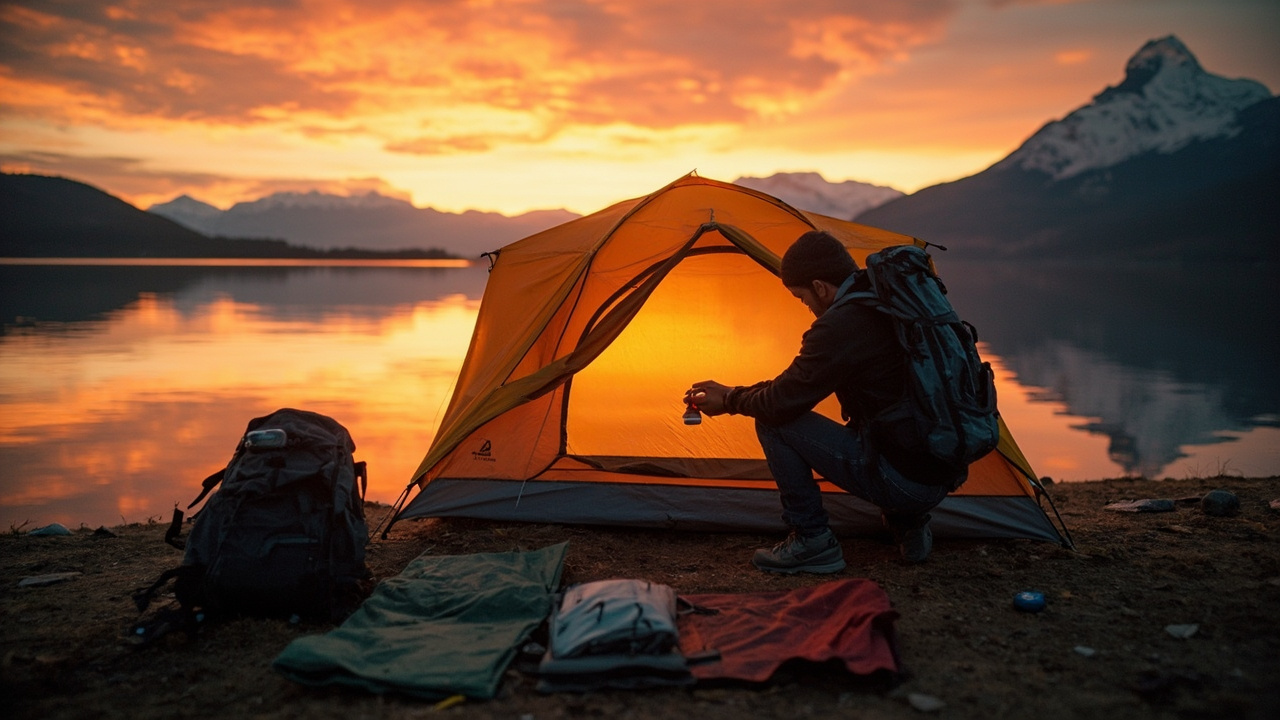
Select shelter for weather, insects, and cold. According to Backpacking for Beginners: How to Start Exploring the Mountains with Confidence, a reliable tent protects from weather, insects, and cold temperatures, and a lightweight two-person backpacking tent offers a good balance between comfort and portability for beginners. Selection factors listed include weight, ease of setup, waterproofing, interior space, and weather resistance. According to TentExplorer's Beginner Camping Checklist: Complete Guide + Free PDF, a 3-season tent suits most beginner trips, a 2-person tent also works for solo campers by providing space to store gear out of the rain, stakes and guylines should be checked before leaving because wind is unpredictable at elevation, and carrying two to three extra stakes is a practical buffer.
Treat ground insulation as mandatory. According to Backpacking for Beginners: How to Start Exploring the Mountains with Confidence, a sleeping pad provides insulation and comfort between sleeper and ground, and even the best sleeping bag loses warmth when used directly on cold ground. Inflatable pads are compact and comfortable, while foam pads are durable and affordable. According to the Beginner Camping Checklist, cold ground pulls heat from the body faster than cold air, a sleeping pad prevents that loss, foam pads are cheaper while inflatable pads pack smaller, and R-value 3+ is listed as a beginner benchmark.
Choose bag warmth with margin. According to Backpacking for Beginners: How to Start Exploring the Mountains with Confidence, mountain temperatures can drop significantly at night even during summer, so choose a sleeping bag rated for temperatures slightly colder than expected. According to the Beginner Camping Checklist, backpackers should match the temperature rating to the expected overnight low and then subtract 10°F as a buffer, with a bag rated to 20°F described as handling most spring-through-fall camping in North America. Store the bag uncompressed between trips.
Add footprint protection. According to the Beginner Camping Checklist, a footprint is a ground cloth that protects the tent floor, extends tent life, adds a thin layer of insulation, and should be cut to tent shape rather than larger.
Dress in layers and break in footwear
Use a three-part clothing system. According to Backpacking for Beginners: How to Start Exploring the Mountains with Confidence, layering allows adjustment to temperature swings and weather conditions, using a moisture-wicking base layer, an insulating mid-layer, and a waterproof outer shell. The same guide advises avoiding cotton whenever possible because it holds moisture and dries slowly.
Prepare feet before the trail. According to Backpacking for Beginners: How to Start Exploring the Mountains with Confidence, supportive hiking boots or trail shoes with good grip can make a large difference, footwear should be broken in ahead of time, moisture-wicking socks should be worn, footwear should be tested on local hikes, and blisters are one of the most common beginner problems.
Carry kitchen gear you have tested
Pack by category rather than memory. According to the Beginner Camping Checklist, packing by category is presented as the most effective way to ensure nothing essential is left behind, organized through a Campsite-Ready Framework of Pack by Category, Test at Home, and Pace Your Drive with a 2-2-2 rule for travel.
For cooking, verify compatibility at home. According to the Beginner Camping Checklist, camp-kitchen items include a camp stove plus fuel with fuel type verified to match the stove before leaving, a lightweight pot or camp cookset, fork, spoon, knife, camp mug, bowl, long-handled spoon or spatula, biodegradable camp soap, and a small sponge. Common first-timer kitchen failures listed are a stove with a dead fuel canister, no pot for boiling water, and food requiring refrigeration.
Prioritize hands-free light. According to the Beginner Camping Checklist, a headlamp worn on the forehead keeps both hands free for stirring, pouring, opening packages, and camp setup and cooking, and spare batteries should be packed. The guide places the headlamp in the kitchen kit rather than buried in the bag.
Plan food, water and storage like a system
Carry calories that are light, dense, and simple. According to Backpacking for Beginners: How to Start Exploring the Mountains with Confidence, backpacking meals should be lightweight, calorie-dense, and easy to prepare, with beginner foods listed as instant oatmeal, trail mix, energy bars, freeze-dried meals, and pasta or rice dishes.
Budget weight and energy realistically. According to A Guide to Backpacking, food equals energy, daily needs can reach 3,000 to 4,000 calories on these trips, maximizing calories per ounce matters, carbohydrates provide quick-release energy for hard passes and final miles to camp, fats provide sustained energy release through the day, protein helps muscles rebuild, and backpackers commonly carry 1 to 1.5 pounds of food per day. Listed trail options include oatmeal, tortilla, tuna, hard cheese or cheeses that do not need refrigeration, freeze-dried meals, ramen packets, nut butter packets, jam packets, and jerky.
Add one backup meal and protect stored food. According to the Beginner Camping Checklist, backpackers should meal-plan for every meal plus one emergency extra such as instant oatmeal or a cliff bar. The same guide states that a bear canister or hang bag is required at many NPS campsites, and proper food storage is mandatory at many federal campsites rather than merely recommended.
Treat all drinking water as a skill, not an accessory. According to Backpacking for Beginners: How to Start Exploring the Mountains with Confidence, backpackers should always carry enough water and understand how to refill safely using filtration systems or purification methods. According to the Beginner Camping Checklist, backpackers should carry at least two reusable water bottles per person plus a water filter or purification tablets. Practice with the filter or tablets before the trip so a first attempt does not happen at a creek.
Practice safety, weather and Leave No Trace
Make the backyard a proving ground. According to the Beginner Camping Checklist, a 10-minute backyard gear test is recommended before departure, including practicing tent setup once at home.
Check the sky and know when to wait. According to A Guide to Backpacking, conditions can shift from sunny one day to rain and thunderstorms the next, and if caught in a rainstorm there may be little to do but ride it out. Lightning response means leaving exposed ridges, and a jacket alone is not protection.
Leave the site clean and legal. According to A Guide to Backpacking, Leave No Trace means packing out all trash including toilet paper, camping on solid ground, and avoiding fires where and when they are prohibited. The principle is summarized as leaving nothing but footprints and taking nothing but photos.
Sources referenced
- Backpacking for Beginners: How to Start Exploring the Mountains with Confidence - Playwest (https://www.playwest.ca/post/backpacking-for-beginners-how-to-start-exploring-the-mountains-with-confidence)
- Beginner Camping Checklist: Complete Guide + Free PDF - TentExplorer (https://tentexplorer.com/packing-checklist-for-tent-camping-essentials/)