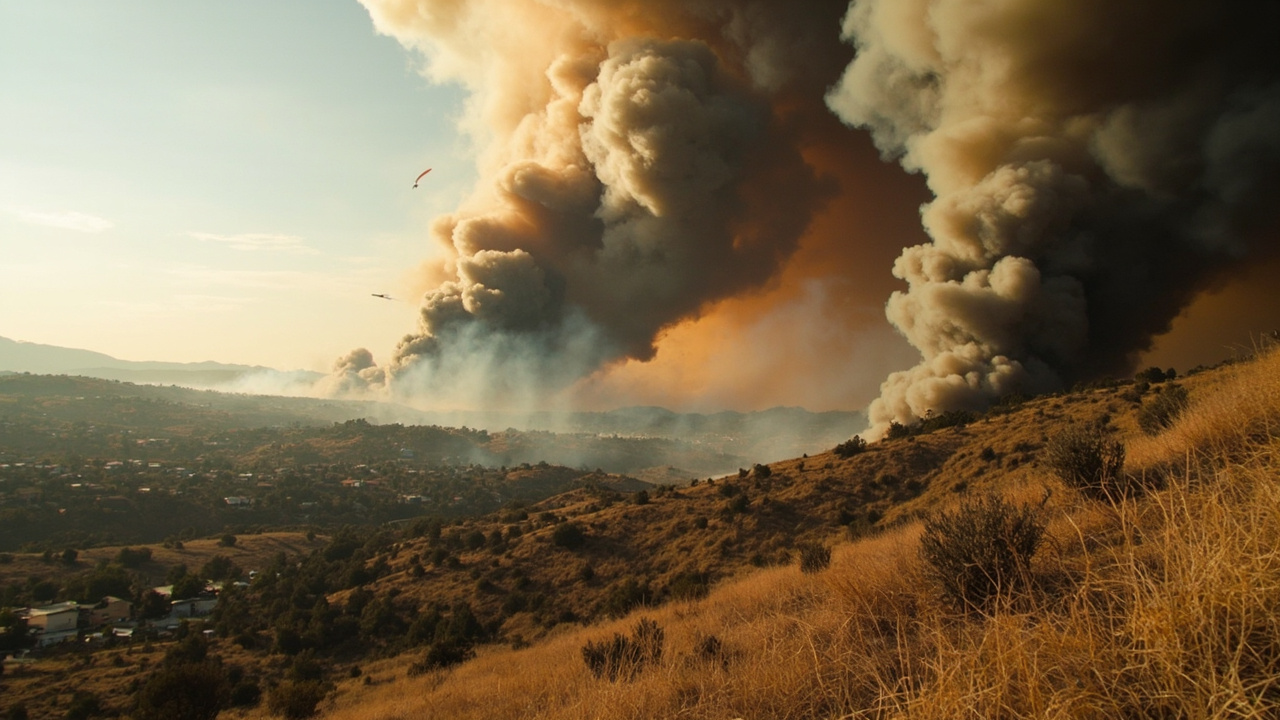
TL;DR: A fast-moving brush fire that started near Sandy Avenue in Simi Valley on the morning of May 18, 2026, burned more than 1,364 acres, forced thousands of homes under evacuation orders, and triggered a federal firefighting grant.
What happened on May 18
The Sandy Fire ignited on May 18, 2026, just after 10 a.m. near Sandy Avenue in Ventura County, according to the Governor of California announcement titled "California secures federal assistance to support response to Sandy Fire in Ventura County."
CAL FIRE's incident page titled "Sandy Fire - CAL FIRE - CA.gov" lists the start as 05/18/2026 at 10:50 AM, with the location described as Off Sandy Ave, Simi Valley, and identifies the Ventura County Fire Department as the agency having jurisdiction.
FOX 11 Los Angeles, in its report titled "Sandy Fire in Simi Valley destroys home, forces thousands to evacuate," placed the first report in the 600 block of Sandy Avenue, near Sycamore Park, around 10:30 a.m. That morning report noted tankers and mutual aid were requested immediately, with an estimated 200 fire personnel at the scene.
The Governor's office described the blaze as fast-moving. The Los Angeles Fire Department alert titled "LAFD ALERT | SANDY FIRE -- Simi Valley" described it as a fast-moving brush fire burning in the area of Sandy Avenue in Simi Valley and estimated at 1,364 acres and moving east.
The Governor's announcement said more than 1,364 acres had burned, threatening several communities in Simi Valley. The cause was listed as under investigation on the CAL FIRE page, and the FOX 11 report also stated that the cause of the fire was under investigation.
How big the evacuation footprint became
The scale of protective actions on May 18 was large and changed through the day as winds pushed the fire.
According to the Governor of California announcement, the fire forced the evacuation of more than 10,000 homes, with an additional 3,500 homes placed under evacuation warnings.
FOX 11 Los Angeles reported that evacuation orders and warnings were in place after the fire erupted late Monday morning, and that nearly 30,000 people were ordered to evacuate at one point on Monday, citing FOX 11 reporter Matthew Seedorff.
Listed evacuation orders in Ventura County on that first-day coverage included Santa Susana 01 and 02, Bell Canyon 01 through 05, Cheseboro 01, Burro Flats 01, Meier Canyon 01, and Simi Valley zones 32A, 33A, 34 and 35. Evacuation warnings were listed for Ventura County zones BOXC-02 and BOXC-03 and multiple Los Angeles County zones, including areas coded for West Hills, Chatsworth, Agoura, Calabasas and Woolsey-area designations.
The LAFD alert confirmed that an evacuation warning was in effect for portions of West Hills and Chatsworth. That alert explained that residents under warning were not required to leave but should be ready to go if conditions changed.
For outdoor recreationists and commuters, the message was direct: fire movement to the east and shifting winds meant people in the San Fernando Valley, Thousand Oaks border country, and Simi Valley hills needed to check local zone maps rather than assume distance meant safety.
Weather that drove first-day spread
Wind and dry air shaped decisions about gear, clothing, and movement on May 18.
FOX 11 Los Angeles reported that flames were pushed by morning gusts that topped 30 mph but were subsiding later in the day, and described persistent critical fire weather in Southern California with dry conditions, high winds and low humidity levels.
The LAFD alert warned that winds were carrying smoke from the Sandy Fire into Los Angeles. It said residents across the San Fernando Valley, including West Hills and Chatsworth, should expect to see and smell smoke that evening and that air quality could be impacted.
That smoke forecast matters for prepared adventurers. A daytime hike can turn into a respiratory hazard even miles from flame when wind aligns with valleys. The LAFD guidance for that evening was to stay indoors, keep windows closed, and limit outdoor activity for anyone sensitive to smoke or with respiratory conditions.
No overnight camping, trail running, or open-land training near Simi Valley made sense while gusts, low humidity, and active tanker operations overlapped. The practical takeaway from May 18 was to postpone backcountry plans, keep vehicles fueled and pointed out, and treat smoke as a reason to change plans early.
Where to go and where to take animals
Officials opened human and animal reception points on May 18 because Simi Valley includes equestrian neighborhoods and small ranches alongside suburbs.
According to FOX 11 Los Angeles, a temporary evacuation center opened at Rancho Santa Susana Community Park. Large animals could be taken to the Ventura County Fairgrounds, while people with small animals could go to the Simi Valley Animal Shelter.
Those three locations solve three different survival-logistics problems. A community park site handles people who need information, restrooms, water, and reunification. A fairgrounds handles horses and livestock that cannot ride in a car. An animal shelter handles dogs, cats, and carriers that should not be left in a hot vehicle during an evacuation queue.
For readers with horses, the May 18 lesson is to keep halters, lead ropes, trailer ramps, water buckets, and proof of ownership where they can be grabbed without entering a smoke-filled barn twice. For small-animal owners, carriers, leashes, food, medications, and vaccination records belong in the same ready load.
Do not wait for flame visibility to load animals. The Governor's office urged residents to stay vigilant during heightened heat and fire weather and to follow guidance from local officials, with evacuation orders in effect at the time of its May 18 announcement.
Who was fighting the fire
The response on May 18 crossed city and county lines.
CAL FIRE noted the incident was not a CAL FIRE incident and listed no incident management team assigned on its page, with jurisdiction retained by Ventura County Fire Department.
FOX 11 Los Angeles reported that information in its story was written with information from the Ventura County Fire Department, underscoring that Ventura County led the tactical fight.
The LAFD alert said Los Angeles City firefighters were assisting Ventura County with the Sandy Fire. It said LAFD deployed strike teams, dozers, a hand crew, and helicopters in support of the incident.
That mix reflects typical wildland-urban interface tactics: hand crews and dozers cut and hold line, helicopters cool hot edges and support ground crews, and strike teams protect structures where homes meet brush. FOX 11 Los Angeles also noted that tankers and mutual aid were requested early, when about 200 personnel were reported at the scene.
The Governor's office added that Governor Gavin Newsom was briefed and monitoring the fire and in touch with local first responders. For residents, unified command means instructions may come from county sheriffs, county fire, city fire, or state emergency officials, so one official dashboard matters more than social video.
Federal help unlocked on day one
California secured a Fire Management Assistance Grant from the Federal Emergency Management Agency on May 18 to bolster response to the Sandy Fire, according to the Governor of California announcement.
The Governor's office said the grant, provided through FEMA on a cost-share basis, will assist local, state, and tribal agencies responding to the fire to apply for 75 percent reimbursement of eligible fire suppression costs.
That funding does not pay individuals to evacuate. It reimburses eligible public suppression costs, which helps counties keep engines, aircraft, dozers, crews, and support functions in the field without immediate budget pause.
The announcement quoted Governor Gavin Newsom saying California was mobilizing resources to support Ventura County communities threatened by the fire and urging Californians in impacted areas to follow guidance from local officials. It also quoted Cal OES Director Caroline Thomas Jacobs saying Cal OES remained committed to ensuring Ventura County had resources needed to protect lives, property, and critical infrastructure.
For prepared households, the grant is a signal of severity, not a substitute for self-reliance. Public reimbursement sustains the larger fight while families still need their own water, respirators, lighting, power bank, medications, documents, and evacuation routes.
Survival checklist drawn from May 18 actions
The LAFD alert listed three information tools: emergency.venturacounty.gov for Sandy Fire updates, lafd.org/alerts for LAFD alerts and information, and notifyla.org to sign up for emergency notifications.
Those links, plus listening for zone-specific orders, matter more than watching distant smoke. Orders on May 18 used formal zone names, not landmarks, so residents needed to know their own zone code before smoke reduced visibility.
Keep a go-bag packed for every person and pet, with water, food, first aid, flashlight, battery bank, N95-style smoke protection, medications, chargers, cash, keys, and copies of identification and insurance. Keep the vehicle backed in with at least half a tank during fire weather. Stage carriers and horse gear before an order arrives.
If a warning becomes an order, leave promptly. Images described by FOX 11 Los Angeles showed residents using garden hoses near homes, but garden hoses do not replace crew-built line, aircraft, and evacuation timing. Leaving early protects both families and firefighters who must otherwise work around late traffic on narrow hillside roads.
Sources referenced
- California secures federal assistance to support response to Sandy Fire in Ventura County | Governor of California (https://www.gov.ca.gov/2026/05/18/california-secures-federal-assistance-to-support-response-to-sandy-fire-in-ventura-county/)