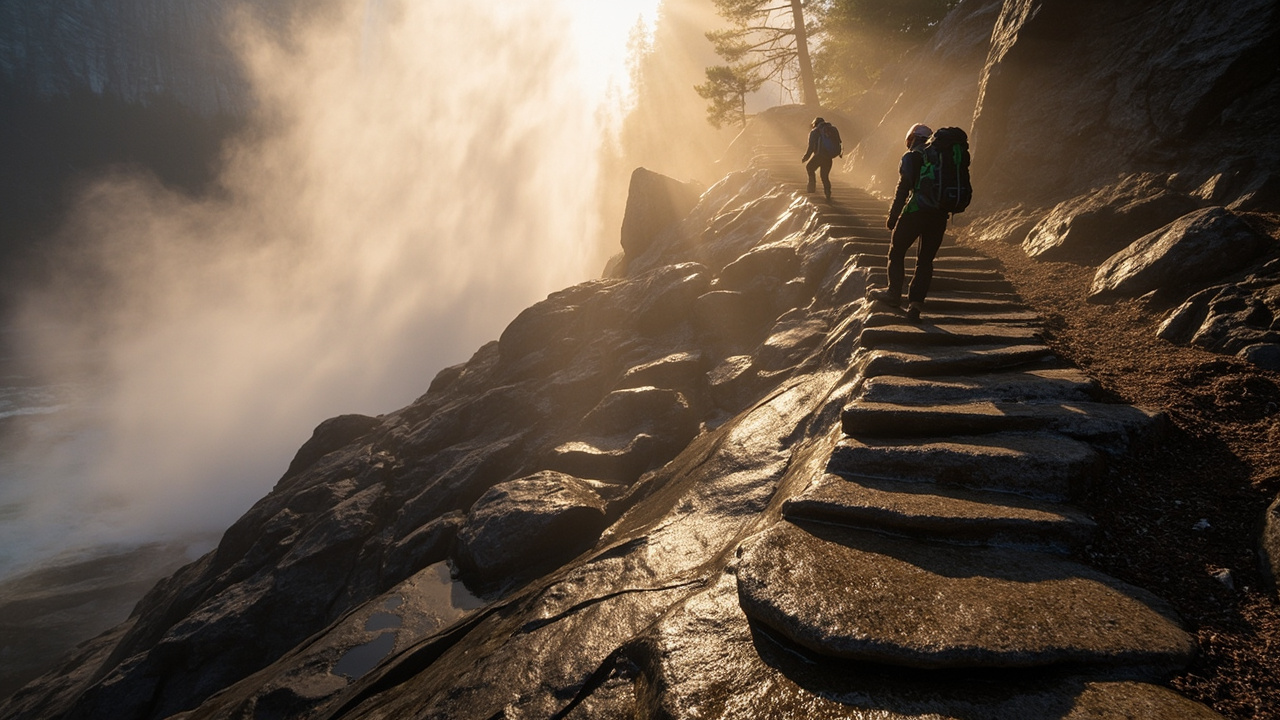
TL;DR: Yosemite's Mist Trail closes Monday through Thursday, 7 a.m. to 3:30 p.m., from June 30 through October 30 for active reconstruction, with weekend access preserved and the John Muir Trail serving as the weekday detour to Vernal and Nevada Falls.
Why the weekday closure starts June 30
Starting June 30, the Mist Trail will close Monday through Thursday from 7 a.m. to 3:30 p.m. for a rehabilitation project that will run through October 30, according to the Buttondown report titled The Mist Trail is closing. Here's what nobody is explaining.
If you hike on a weekday during business hours after that date, you will not be able to use the most popular trail corridor in the park. The trail will be open Fridays, Saturdays, Sundays, and holidays throughout the construction window.
During closure hours, hikers headed toward Vernal and Nevada Falls will be detoured onto the John Muir Trail, which reaches the top of both falls from a longer, less steep route, according to that same Buttondown report.
A separate trail-status summary published by Newz.com on June 7 describes the same seasonal pattern in corridor terms. It states that the Mist Trail from its junction with the John Muir Trail to the top of Vernal Fall will be open on Fridays through Sundays and holidays from June 30 through October, with specific hours applying on other days.
That Newz.com summary also notes an overlapping repair in the same network. The John Muir Trail between Clark Point and the Panorama Trail junction is closed through mid-July for trail repairs, with a detour via the Mist Trail available. The two corridors therefore trade detour duties during different weeks of the summer season.
The Panorama Trail will be closed in the vicinity of the John Muir Trail junction on specific dates due to helicopter operations, according to Newz.com. The Half Dome cables are up for the season, and a permit is required to hike to the top of Half Dome.
How busy this corridor really is
The Mist Trail carries roughly 85,000 hikers per summer, according to the Buttondown report. On peak days, the National Park Service estimates up to 5,000 people walk this corridor in a single day.
That daily figure exceeds what many trails elsewhere receive in a full month. For prepared hikers, the number explains both the wear on stone and tread and the reason construction cannot proceed while crowds move through.
The scale also explains the accident pattern. The lower trail between Happy Isles and the Vernal Fall footbridge has been the site of more visitor accidents than any other trail segment in the park, according to the Buttondown report.
Crowding compounds hazard exposure. When thousands of people share narrow steps, passing, stopping for photographs, and moving in opposite directions all occur in the same constricted space.
June 2026 adds broader congestion pressure. More than 836,000 visits were recorded through late May, roughly 100,000 more than the same period last year, according to The Talus Field report Yosemite in June 2026. On Memorial Day weekend, Valley parking lots were full by mid-morning and entrance waits exceeded ninety minutes.
There is no entry reservation requirement in 2026. You do not need a reservation to enter Yosemite in 2026, although the park entrance fee still applies when you arrive, according to the National Park Service Frequently Asked Questions page for Yosemite.
A 130-year-old staircase under modern load
The first Euro-American trail through this corridor dates to the mid-1850s, making it one of the oldest constructed trails in any national park, according to the Buttondown report.
The stone steps that take hikers up through the spray zone of Vernal Fall date to 1897, when they replaced the original wooden staircase. The Civilian Conservation Corps upgraded sections in the 1930s. Some of what visitors walk today is infrastructure that is nearly 130 years old.
Those steps were built roughly two feet wide. That width must now accommodate two-way traffic on days with as many as 5,000 users.
The present condition reflects that mismatch. Visitors encounter deteriorating asphalt patches on the lower sections, eroded granite treads, social trails branching off into fragile habitat where hikers have left the main path to pass slower groups, trampled streamside vegetation, and signage that confuses more visitors than it directs, according to the Buttondown report.
Rockfall remains an ongoing hazard in the corridor. Most recently in early 2024 near the footbridge, a rockfall from Grizzly Peak closed the trail between Happy Isles and the Vernal Fall footbridge.
For readiness planning, the lesson is direct. Old stone, narrow width, water, spray, and heavy bidirectional use create slip, trip, and fall exposure even before construction equipment enters the corridor.
What crews will rebuild this summer
The project has two phases, according to the Buttondown report. The work happening this summer is active construction.
Tasks include widening steps, replacing deteriorated stonework, stabilizing retaining walls, improving drainage, and rerouting social trails back onto the main corridor.
Each replacement granite block weighs roughly 200 pounds and is pulleyed down from a quarry above the trail. The method shows why the site needs separation from hikers. Heavy stone, rigging lines, retaining-wall work, and drainage excavation cannot be conducted safely with thousands of people walking through the construction zone.
That safety requirement is the reason for the Monday-through-Thursday daytime closure pattern rather than a full-season closure.
The financing scale is substantial. The rehabilitation is a $5 million investment, according to the Buttondown report. Yosemite Conservancy committed $500,000 to the design phase alone. The park's Legendary Valley Trails program, funded by Yosemite Conservancy donors for 21 consecutive seasons, has maintained the Mist corridor and others across the Valley floor.
When visitors return in later seasons, the stated objectives are wider steps, stable surfaces, functioning drainage, and streamside habitat recovering from social-trail damage.
The longer corridor plan and your comment window
The second phase is planning, not construction, according to the Buttondown report. The National Park Service released a Draft Environmental Assessment for the broader Mist Trail Corridor Plan.
The public comment period opens June 11 and runs through July 13. The assessment evaluates two alternatives: improving the existing trail alignment, or re-establishing the historic Happy Isles Footbridge route that was damaged in the 1997 flood and never rebuilt.
A Record of Decision is expected in 2027. The project page is on the NPS Planning, Environment and Public Comment site at parkplanning.nps.gov, project ID 105979.
For hikers who care about width, alignment, habitat protection, and emergency access over the next century, that June-to-July window is the formal mechanism for input.
The Newz.com trail summary, last updated June 5, 2026, separately reminds visitors that trails may be closed due to rockfall, snow, ice, or fire, that open trails may still present hazards, and that visitors should exercise good judgment and assume responsibility for safety.
Climbing closures are also in effect on several routes from March 1 through July 15 to protect peregrine falcons, and a wilderness climbing permit is required for all overnight big wall climbs, according to Newz.com.
How to still reach Vernal and Nevada Falls
The John Muir Trail detour reaches the top of both Vernal Fall via the Clark Point cutoff and Nevada Fall, according to the Buttondown report. It is longer and less dramatic than the Mist Trail route, but it offers broader views of the Valley.
You will miss the spray zone on that alternate. You will still reach the waterfalls.
If you are visiting in the first two weeks of June, the trail is still open daily until June 30. That early-June window also matters for water. With low snowpack this year, waterfall flows peaked early and were already declining by late May, according to The Talus Field.
The Sierra Nevada snowpack on April 1, 2026 was measured at roughly 18 percent of average, the second-lowest figure in recorded history, according to The Talus Field. In that report, Yosemite Falls was expected to weaken noticeably by mid-June and reduce to a trickle by early July, while Bridalveil Fall, with a smaller watershed, was expected to thin sooner.
That hydrology makes timing important for photographers and waterfall-focused hikers. The first two weeks of June offer both daily Mist Trail access and stronger flows than later in the summer.
If you visit on a weekend after June 30, the Mist Trail remains open. Plan for an early start because Valley lots fill quickly. The Talus Field reports that Valley parking was full since 7:30 on a Saturday morning during the Tioga Road opening weekend, while eight cars were counted at the Cathedral Lakes trailhead at 9 a.m. that same morning.
Readiness checklist for closure-season hiking
Treat a closure-season Mist Trail trip as a logistics problem. Confirm the weekday hours before leaving camp or lodging. Build the John Muir Trail alternate into your time plan because it adds distance.
Tioga Road opened on May 15, 2026, the earliest opening since 2015, according to The Talus Field. Glacier Point Road opened on May 9. Tuolumne Meadows Lodge opened June 5. Those openings give weekday visitors a pressure valve when the Valley is congested.
The trail to Lower Cathedral Lake is about 3.5 miles one way with roughly 1,000 feet of gain, ending at a granite-rimmed alpine lake beneath Cathedral Peak, according to The Talus Field. In early June it may still hold snow patches on the upper trail.
Camping requires advance planning. Camping and sleeping in a vehicle are allowed only in registered campsites, according to Newz.com. Upper Pines, Lower Pines, North Pines, Camp 4, Wawona, Hodgdon Meadow, and Crane Flat were listed as open with reservations required, while Bridalveil Creek, White Wolf, Yosemite Creek, Tuolumne Meadows, Tamarack Flat, and Porcupine Flat were listed as closed. Reservations are available up to five months in advance and are strongly recommended.
Carry traction devices if traveling high before mid-month, check official trail postings for helicopter-related Panorama closures, secure a Half Dome permit before attempting the cables, and leave social trails alone so streamside vegetation can recover while crews rebuild the main tread.
Sources referenced
- The Mist Trail is closing. Here's what nobody is explaining. • Buttondown (https://buttondown.com/goehring/archive/the-mist-trail-is-closing-heres-what-nobody-is/)
- Explore Yosemite National Park: Essential Road Conditions, Camping Availability, and Trail Updates (https://www.newz.com/explore-yosemite-national-park-essential-road-conditions-camping-availability-and-trail-updates/)