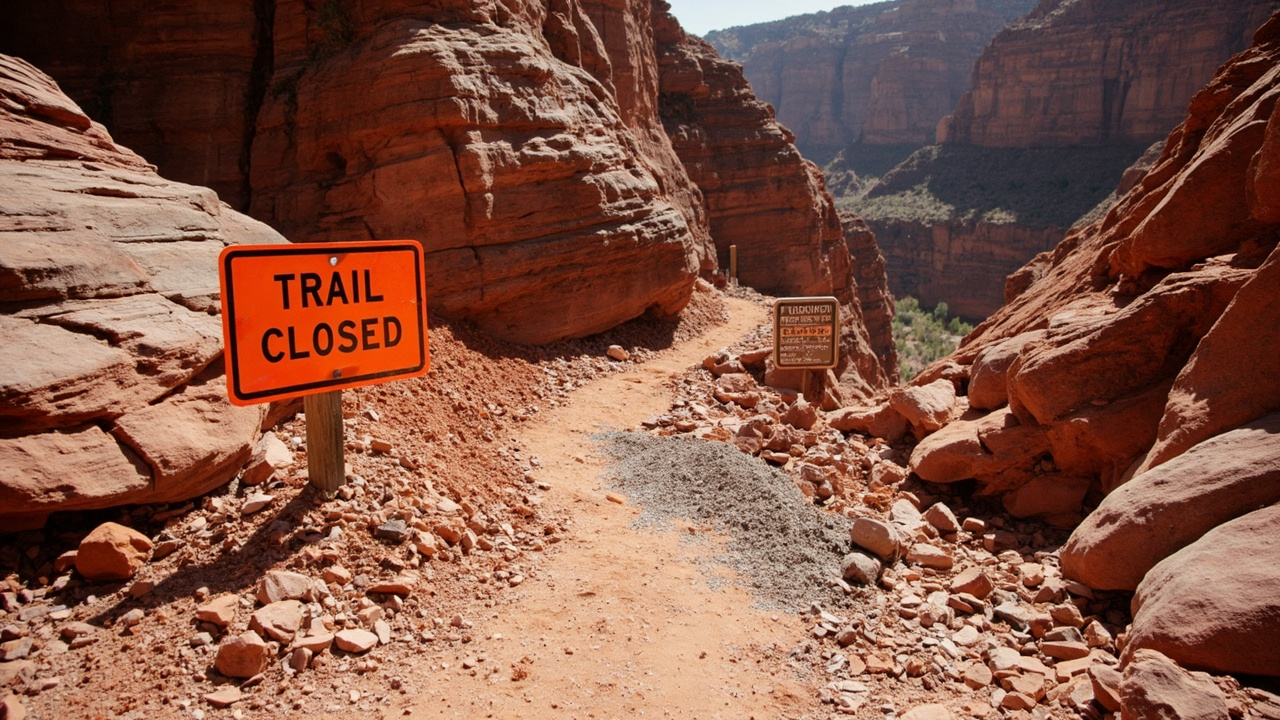
TL;DR: Bright Angel Trail is closed between Mile-and-a-Half Resthouse and Havasupai Gardens after a rockfall, starting Tuesday at 11:00 p.m. for a minimum of 72 hours while crews clear the area for hikers and stock.
A recent rockfall has forced the closure of Bright Angel Trail at Grand Canyon National Park between Mile-and-a-Half Resthouse and Havasupai Gardens, according to ABC4 reporting on the rock fall trail closure.
The trail will close on Tuesday at 11:00 p.m. and will remain closed for a minimum of 72 hours, according to that same ABC4 report published October 14, 2026.
Park officials said the closure is necessary to protect visitor safety and allow crews to safely clear the area for hikers and stock.
Park officials are asking the public to avoid this section of trail while crews work to complete this work, according to ABC4.
There is no further information available at this time about the rockfall clearing operation, according to ABC4.
What Is Closed And When
The closed segment runs from Mile-and-a-Half Resthouse to Havasupai Gardens on Bright Angel Trail.
That closure point matters for day hikers because Mile-and-a-Half Resthouse is listed as a 3-mile roundtrip destination taking 2-4 hours with 1,120 feet of elevation change, according to the National Park Service Bright Angel Trail page.
Three-Mile Resthouse, at 6 miles roundtrip taking 4-6 hours with 2,120 feet of elevation change, sits inside the closed interval and is therefore inaccessible during the closure, according to the same National Park Service Bright Angel Trail page.
Havasupai Gardens, at 9 miles roundtrip taking 6-9 hours with 3,040 feet of elevation change, marks the lower end of the rockfall closure, according to that National Park Service Bright Angel Trail page.
The National Park Service advises checking with a park ranger before attempting Havasupai Gardens as a day hike, according to its Bright Angel Trail page.
The 72-hour minimum means hikers and stock users should not plan to pass through the Mile-and-a-Half to Havasupai Gardens section until crews have declared it clear.
Avoiding the section keeps the work zone clear for response personnel moving rock and stabilizing tread.
How This Fits Wider Inner-Canyon Closures
The rockfall closure overlaps areas already affected by hazardous conditions caused by flash flooding, according to the National Park Service Key Hiking Messages page.
That National Park Service Key Hiking Messages page lists Bright Angel Trail between Mile-and-a-Half Resthouse and Havasupai Gardens as closed.
The same page lists South Kaibab Trail below Tip-Off Point as closed.
The same page lists the River Trail east of the River Resthouse to the South Kaibab Trail junction as closed.
The same page lists Black Bridge and Silver Bridge spanning the Colorado River as closed.
The same page lists the entirety of Phantom Ranch, including Bright Angel Campground, the Phantom Ranch Canteen, and Phantom Ranch cabins, as closed.
The same page lists the entirety of the North Kaibab Trail from the North Kaibab Trailhead to Phantom Ranch, including Cottonwood Campground, as closed.
The North Kaibab closure is a result of significant flash flooding to Bright Angel Canyon on 8/29, according to that National Park Service Key Hiking Messages page.
Boat Beach is closed to all activities except emergencies and brief scouting of the new rapid formed at the mouth of Bright Angel Creek, according to the same page.
These closures are required to protect visitors from numerous hazards, and to allow for damage assessments and repair and stabilization work, according to the same page.
There is no estimated reopening of these closure areas at this time, according to the same page.
Background: August 29 Flood Response
Grand Canyon National Park continues response and recovery operations following the destructive August 29 flash flood that caused significant damage in Bright Angel Canyon and the Phantom Ranch area, according to the National Park Service news release expanding inner canyon closures.
Park staff and partner agencies are conducting damage assessments and beginning repair and stabilization work in areas where trails, bridges, utilities and other infrastructure were damaged or destroyed, according to that September 3, 2026 news release.
Maintaining safe access for response personnel and keeping visitors out of hazardous areas is critical as this work continues, according to that news release.
To support these operations and protect visitor safety, the park expanded temporary closures in portions of the inner canyon effective immediately, according to that news release.
Those expanded closures included South Kaibab Trail below the Tip-Off and Bright Angel Trail below the intersection with the Tonto Trail, according to that news release.
Commercial and non-commercial river trips may continue to conduct exchanges at Pipe Creek Beach along the Bright Angel Trail, according to that news release.
The North Kaibab Trail, Cottonwood Campground, Phantom Ranch, the Bright Angel Campground, and the Black Bridge and Silver Bridge were previously closed following the August 29 flash flood, according to that news release.
Reopening decisions will be based on conditions on the ground and the park's ability to safely restore access, according to that news release.
Park staff will continue evaluating damaged areas as response, recovery, assessment and stabilization work progresses, according to that news release.
What Remains Open On The South Rim Corridor
Bright Angel Trail from the Bright Angel Trailhead to Mile-and-a-Half Resthouse is listed as currently open, according to the National Park Service Key Hiking Messages page.
Plateau Point Trail to Plateau Point is listed as currently open, according to that same page.
South Kaibab Trail from the South Kaibab Trailhead to the Tip-Off is listed as currently open, according to that same page.
Tonto Trail between the Tip-Off to Havasupai Gardens is listed as currently open, according to that same page.
The September 14, 2026 update on the National Park Service Bright Angel Trail page separately lists Bright Angel Trail from the Bright Angel Trailhead to the River Resthouse as currently open, alongside Plateau Point Trail to Plateau Point, South Kaibab Trailhead to the Tip-Off, and Tonto Trail between the Tip-Off to Havasupai Gardens.
Hikers using the open upper section of Bright Angel Trail can still reach First Tunnel at 0.1 miles roundtrip in 20 minutes and Second Tunnel at 1.8 miles roundtrip in 1-2 hours with 590 feet of elevation change, according to the National Park Service Bright Angel Trail page.
Destinations below Havasupai Gardens are not recommended as day hikes due to the long distance, extreme temperature changes, and an approximately 5,000-foot elevation change each way, according to that same page.
Water: Carry It And Treat It
To conserve the South Rim's limited potable water supply, water has been turned off at 1.5-Mile Resthouse, 3-Mile Resthouse and Havasupai Gardens Day Use Area and Campground, according to the National Park Service Bright Angel Trail page updated Sunday, Sept. 6, 2026.
Day hikers on Bright Angel Trail should carry all the water they will need and should not rely on water being available along the trail, according to that same page.
Overnight visitors at Havasupai Gardens Campground should carry sufficient water for their stay or be prepared to collect and properly treat water from natural sources, according to that same page.
All hikers should carry a reliable water treatment method, according to that same page.
The National Park Service Key Hiking Messages page states that potable drinking water is available in a large black tank adjacent to the restrooms at Bright Angel Trailhead and South Kaibab Trailhead.
The same Key Hiking Messages page lists water as OFF at North Kaibab Trailhead, Supai Tunnel, Manzanita Day Use Area, Cottonwood Campground and Day Use Area, Phantom Ranch Canteen, Bright Angel Campground, Phantom Delta Restroom, Phantom Boat Beach, Havasupai Gardens, Three-Mile Resthouse, and Mile-and-a-Half Resthouse.
Day and overnight hikers should always carry water treatment options, according to that National Park Service Key Hiking Messages page.
Water from natural sources such as creeks and springs should be purified, according to the National Park Service Bright Angel Trail page.
When hiking in a group, each person should be carrying water, according to that same page.
Trail Character And Access Details
Bright Angel Trail is considered the most popular hiking trail in the park, according to the National Park Service Bright Angel Trail page.
The trail is located at Grand Canyon Village and is designated as a Corridor Trail, according to that same page.
The trail lets hikers walk in the footsteps of the canyon's Indigenous peoples, miners, and early tourists as they descend into the canyon's depths, according to that same page.
While South Kaibab Trail follows a ridge line, Bright Angel Trail is tucked deep within a side canyon along a massive fault, which keeps the trail in this side canyon for the first few miles, according to that same page.
The majority of the trail's elevation change takes place in the upper four miles via a series of switchbacks, according to that same page.
Views are framed by massive cliffs, with more plant and animal life thanks to a higher degree of shade and natural water sources, according to that same page.
All trails into the canyon are steep and difficult, according to that same page.
Plan for at least twice as much time back up as it took to go down, according to that same page.
If parking is not available near Bright Angel Trailhead, drivers are directed to continue around Village Loop Drive to Parking Lot D by Maswik Lodge and the Backcountry Information Center, according to that same page.
From Lot D, it is about a 0.4 mile / 0.65 km walk back to the canyon's rim and Bright Angel Trailhead, according to that same page.
If parked at the Visitor Center, the Village Blue Route shuttle brings visitors to Hermit Road Interchange, from which it is a short walk uphill to Bright Angel Trailhead, according to that same page.
Safety Playbook For Rockfall And Heat
Rock falls are common during or after rain, or during freeze/thaw events, according to the National Park Service Key Hiking Messages page.
Horses and stock users on inner canyon corridor trails should check with the Backcountry Information Center prior to entering the inner canyon with stock, according to that same page.
Rockslides and trail washouts have at times made trails impassable to stock, according to that same page.
Flash flooding can occur along the lower North Kaibab Trail and in the Phantom Ranch area with little to no warning, even when storms are not visible overhead, according to that same page.
In summer, hikers are advised not to hike between 10 a.m. and 4 p.m., according to that same page.
Hikers are advised not to force fluids, to drink water when thirsty, and to stop when quenched, according to that same page.
Over-hydration may lead to a life-threatening salt-balance disorder called hyponatremia, according to that same page.
Hikers are advised to eat double the normal intake of carbohydrates and salty foods, according to that same page.
Hikers are advised to take plenty of breaks and enjoy the view while resting, according to that same page.
If feeling nauseated, dizzy, or exhausted, hikers are advised to stop and rest, then slowly begin to drink and eat until feeling better, a process that can take an hour or longer, according to that same page.
Before heading down, hikers should consult signs at the trailhead and scan the QR code for trip planning, current weather, water availability, and trail information and closures, according to the National Park Service Bright Angel Trail page.