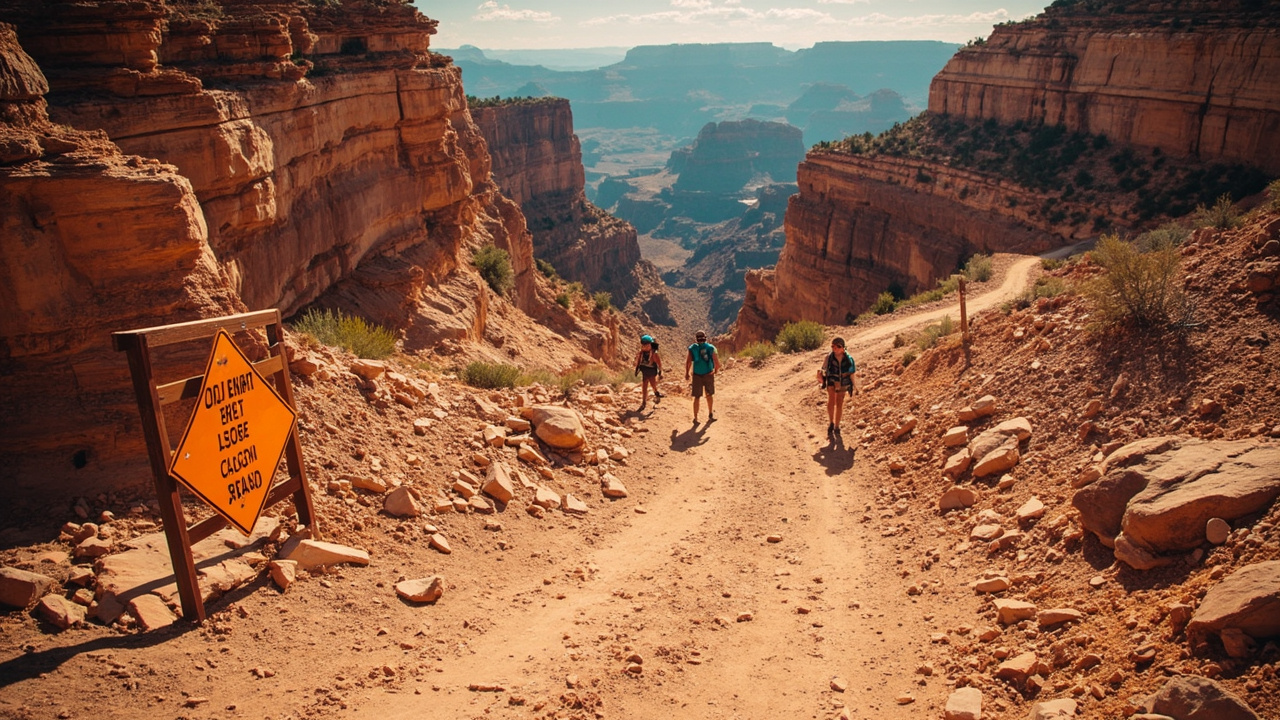
TL;DR: Bright Angel Trail is closed between Mile-and-a-Half Rest House and Havasupai Gardens for a minimum of 72 hours from 11 p.m. Tuesday while crews clear rockfall debris for hikers and stock.
Rockfall Blocks Middle of Bright Angel Trail, Halting Through-Hikes
A rockfall has forced a partial closure of Bright Angel Trail at Grand Canyon National Park between Mile-and-a-Half Rest House and Havasupai Gardens, starting at 11:00 p.m. Tuesday for a minimum of 72 hours while crews clear the area for hikers and stock.
According to ABC4 reporting on the rock fall trail closure, park officials said the closure is necessary to protect visitor safety and allow crews to safely clear the area. According to that same ABC4 report, published Oct. 14, 2026, park officials are asking the public to avoid this section of trail while crews complete the work.
There is no further information available at this time about the clearing operation, according to ABC4. The minimum 72-hour window means the segment does not reopen automatically after three days, and passage depends on crews declaring the tread safe.
According to American Parks reporting on the section closed after rockfall, the closure affects the middle stretch of the descent on what it describes as the most popular route down to the bottom of the canyon from the South Rim. The National Park Service Bright Angel Trail page describes Bright Angel Trail as the most popular hiking trail into Grand Canyon and notes that all trails into the canyon are steep and difficult.
What Is Closed And When The Clock Starts
The closed interval runs from Mile-and-a-Half Rest House to Havasupai Gardens on Bright Angel Trail, according to ABC4.
The closure took effect at 11 p.m. on Oct. 14, 2026, for a minimum of 72 hours, according to American Parks, which cited KUTV. That timing places the earliest possible end of the minimum window on the evening of Oct. 17, although the park has not promised reopening at that point.
According to American Parks, the upper part of the trail above Mile-and-a-Half Rest House is not affected by this particular stretch, but cutting the trail in the middle makes progress toward the bottom impossible along this route. Hikers who planned to descend to Havasupai Gardens, formerly known as Indian Garden, by way of Bright Angel Trail will have to postpone or reroute while the closure holds, according to that same American Parks report.
The National Park Service Key Hiking Messages page lists Bright Angel Trail between Mile-and-a-Half Resthouse and Havasupai Gardens as closed. That National Park Service page states the closure will remain in effect through Thursday, Oct. 22, in the section headed closed due to hazardous conditions caused by flash flooding.
Park officials are asking the public to avoid the closed section while crews work to complete this work, according to ABC4. Staying out keeps the work zone clear for response personnel moving rock and stabilizing tread.
Why Crews Need At Least 72 Hours
Park officials said the closure is necessary to protect visitor safety and allow crews to safely clear the area for hikers and stock, according to ABC4.
According to American Parks, park crews are clearing debris both to protect hikers and to keep the pack animals that use this trail safe. Work like this cannot be rushed, and the 72-hour window is a minimum, not a guaranteed reopening, according to that American Parks report.
The National Park Service Key Hiking Messages page states that closures are required to protect visitors from numerous hazards and to allow for damage assessments and repair and stabilization work. There is no estimated reopening of these closure areas at this time, according to that National Park Service page.
The closed middle section concentrates the risk because loose rock can continue to shift after the initial fall. Keeping hikers and stock out during the minimum window gives crews room to remove debris and check stability without foot traffic passing below or above the work site.
Hikers should check trail conditions that same morning, build slack into schedules, and have a backup plan on the rim in case the descent falls through, according to American Parks. For trip planning, that outlet points readers to its Grand Canyon park guide covering entrances and hikes and to a road-trip itinerary that runs through the park.
What Remains Listed Open On The South Rim Corridor
The National Park Service Key Hiking Messages page lists Bright Angel Trail from the Bright Angel Trailhead to Mile-and-a-Half Resthouse as currently open. That listing defines the top limit for a legal out-and-back on Bright Angel while the rockfall closure holds.
The same National Park Service page lists Plateau Point Trail to Plateau Point as currently open. It also lists South Kaibab Trail from the South Kaibab Trailhead to the Tip-Off as currently open.
That page also lists Tonto Trail between the Tip-Off to Havasupai Gardens as currently open. The National Park Service Bright Angel Trail page separately lists currently open segments as Bright Angel Trail from the Bright Angel Trailhead to the River Resthouse, Plateau Point Trail to Plateau Point, South Kaibab Trail from the South Kaibab Trailhead to the Tip-Off, and Tonto Trail between the Tip-Off to Havasupai Gardens.
If parking near Bright Angel Trailhead is unavailable, the National Park Service Bright Angel Trail page directs drivers to continue around Village Loop Drive to Parking Lot D by Maswik Lodge and the Backcountry Information Center. From Lot D, it is about a 0.4 mile / 0.65 km walk back to the canyon rim and Bright Angel Trailhead, according to that National Park Service page.
If hikers park at the Visitor Center, the Village Blue Route shuttle brings riders to Hermit Road Interchange, and from there it is a short walk uphill to Bright Angel Trailhead, according to that same National Park Service page. Before heading down, hikers should consult signs at the trailhead and scan the QR code for trip planning, current weather, water availability, and trail information and closures, according to that National Park Service page.
Wider Inner-Canyon Closures Still In Effect
The rockfall closure sits inside a broader set of inner-canyon restrictions. The National Park Service Key Hiking Messages page groups several closures under hazardous conditions caused by flash flooding.
That National Park Service page lists South Kaibab Trail below Tip-Off Point as closed. It lists the River Trail east of the River Resthouse to the South Kaibab Trail junction as closed.
That page lists Black Bridge and Silver Bridge spanning the Colorado River as closed. It lists the entirety of Phantom Ranch, including Bright Angel Campground, the Phantom Ranch Canteen, and Phantom Ranch cabins, as closed.
The same page lists the entirety of the North Kaibab Trail from the North Kaibab Trailhead to Phantom Ranch, including Cottonwood Campground, as closed. That North Kaibab closure is a result of significant flash flooding to Bright Angel Canyon on 8/29, according to that National Park Service page.
Boat Beach is closed to all activities except emergencies and brief scouting of the new rapid formed at the mouth of Bright Angel Creek, according to that same National Park Service page. The National Park Service Bright Angel Trail page separately lists as closed due to hazardous conditions and repair work the South Kaibab Trail below Tip-Off Point, the River Trail east of the River Resthouse to the South Kaibab Trail junction, Black Bridge and Silver Bridge, and the entirety of Phantom Ranch including Bright Angel Campground.
These overlapping closures mean a rim-to-river itinerary on Bright Angel cannot be completed while the restrictions hold. Even where an upper trail segment is listed open, the onward connection to the river, bridges, campground, and Phantom Ranch remains blocked.
Water Is Off At Three Bright Angel Stops
Water planning is now as limiting as the rockfall itself. The National Park Service Bright Angel Trail page states that to conserve the South Rim's limited potable water supply, water has been turned off at 1.5-Mile Resthouse, 3-Mile Resthouse and Havasupai Gardens Day Use Area and Campground, updated Sunday, Sept. 6, 2026.
Day hikers on Bright Angel Trail should carry all the water they will need and should not rely on water being available along the trail, according to that National Park Service page. Overnight visitors at Havasupai Gardens Campground should carry sufficient water for their stay or be prepared to collect and properly treat water from natural sources, according to that same National Park Service page.
All hikers should carry a reliable water treatment method, according to that National Park Service page. The National Park Service Key Hiking Messages page states that day and overnight hikers should always carry water treatment options and points to instructions on how to treat water at its safe-water page.
That Key Hiking Messages page lists water as OFF at North Kaibab Trailhead, Supai Tunnel, Manzanita Day Use Area, Cottonwood Campground and Day Use Area, Phantom Ranch Canteen, Bright Angel Campground, Phantom Delta Restroom, and Phantom Boat Beach. It lists water as OFF to conserve water at Havasupai Gardens, Bright Angel Trail Three-Mile Resthouse, and Bright Angel Trail Mile-and-a-Half Resthouse.
Potable drinking water is available in a large black tank adjacent to the restrooms at Bright Angel Trailhead, according to that National Park Service page. Potable drinking water is available in a large black tank adjacent to the restrooms at South Kaibab Trailhead, according to that same page.
On the North Rim, all water is OFF, and water in single bottles and gallon-sized containers can be purchased at the General Store from 9 a.m. to 4 p.m. daily, according to that National Park Service page. With all inner-canyon water turned off, hikers should carry sufficient water for the trip or be prepared to collect and properly treat water from natural sources, according to that page.
Heat, Pacing And Body Care For Shorter Rim Hikes
With the middle of Bright Angel blocked, many visitors will shift to shorter upper-canyon walks, but heat and grade remain serious. The National Park Service Key Hiking Messages page states that in the inner canyon, temperature increases 5.5°F with each 1,000 feet loss in elevation. Summer highs at Phantom Ranch can average around 30°F warmer than on the canyon rims, according to that page.
In summer, hikers should not hike between 10 a.m. and 4 p.m., according to that National Park Service page. The same page warns not to force fluids, to drink water when thirsty, and to stop when quenched, noting that over-hydration may lead to a life-threatening salt-balance disorder called hyponatremia.
Hikers should eat double the normal intake of carbohydrates and salty foods, according to that National Park Service page. That page states that calories play an important role in regulating body temperature and that hiking suppresses appetite.
Hikers should take plenty of breaks and enjoy the view while resting, according to that page. Resting allows time for proper digestion, according to that page.
If hot, hikers should cool off by getting wet in creeks and water stations, according to that page. If cold, hikers should put on layers and eat food, according to that page.
If hikers start to feel nauseated, dizzy, or exhausted, they should stop and rest, according to that page. They should slowly begin to drink and eat until feeling better, which can take an hour or longer, according to that same page.
What Prepared Hikers Should Do Now
Avoid the section between Mile-and-a-Half Rest House and Havasupai Gardens while crews work, as park officials request, according to ABC4. Do not enter a closed work zone to look at debris, pass stock, or test whether the tread is passable.
Check the National Park Service Key Hiking Messages page the same morning before leaving the rim, because water statuses for corridor trails are current but can change suddenly due to breaks in the waterline, according to that page. Carry all water needed for the planned turnaround at or above Mile-and-a-Half Resthouse, and carry a reliable treatment method even for a day hike, as directed on the National Park Service Bright Angel Trail page.
Keep an upper-canyon turnaround flexible and be ready to shorten the day if heat, thirst, nausea, dizziness, or exhaustion appear. Rest, drink slowly, and eat until recovery, which can take an hour or longer, according to the National Park Service Key Hiking Messages page.
Sources referenced
- Rock fall forces closure of Bright Angel Trail at Grand Canyon National Park - ABC4 (https://www.abc4.com/arizona/rock-fall-trail-closure-grand-canyon/)
- Grand Canyon: Section of Bright Angel Trail Closed After Rockfall - American Parks (https://american-parks.com/en/news/parks/grand-canyon/2026/10/section-of-bright-angel-trail-closed-after-rockfall/)